ROC Stories
Introduction
ROCStories are simple stories of four sentences. In the test set, two sentences are added to each story, one of which is a meaningful continuation of the story, while the second is not. For example:
Karen was assigned a roommate her first year of college.
Her roommate asked her to go to a nearby city for a concert.
Karen agreed happily. The show was absolutely exhilarating.
- Karen became good friends with her roommate. (right ending)
- Karen hated her roommate. (wrong ending )
Training data contain five sentences (story and its correct continuation).
There is a file
100KStories.csv
(see also the file 100KStories.zip)
with 98'167 stories, totaling 4'859'629 tokens
and 36'566 unique word forms.
For comparison, one volume of "War and Peace" contains about 150'000 tokens,
and wikipedia has several billion.
Loading Stories
Since the dataset is in a csv file, we will use the library pandas. We will save stories in the list docs. Each training story is a list of 5 sentences. The first two columns of the csv file are service columns:
import re                                                        # regular expressions
import pandas as pd                                              # csv files

df = pd.read_csv('100KStories.zip', sep=',')                     # read from zip file

docs = []                                                        # list of stories
for i in range( len(df) ):
    sents = []                                                   # list of sentences
    for j in range(5):
        sents.append( preprocessing( df.iloc[i,2+j]) )           # add sentence
    docs.append(sents)                                           # add story
Before saving sentences, a small preprocessing is performed: in the preprocess function, specific spaces, quotes are removed, everything is converted to lowercase and punctuation marks are separated from words:
def preprocess(s):
    s = s.translate( {ord(c): ' ' for c in "\u202f\u200b\xa0"} ) # different spaces to ' '
    s = s.translate( {ord(c): ' ' for c in "\"«»"} )             # quotes to ' '
    s = re.sub( '\s+', ' ', s).strip()                           # multiple spaces to one
    s = s.lower()                                                # to lowercase

    res = []
    for i, ch in enumerate(s):                                   # separate punctuation
        if ch in ".,:;!?…%" and s[i-1] != ' ': res.append(' '+ch)
        else:                                  res.append(ch)

    return (' '+ "".join(res)+' ' )                              # for search like ' cat '
Word Vocabulary
To compile the vocabulary, we will use the Counter object from the standard library collections:from collections import Counter words = [w for d in docs for s in d for w in s.split()] cnt = Counter(words) # vocabulary tokens = len(wrds) # total words in textIn the wordID dictionary we will store the word number (id) and the number of its occurrences per million words (pm), keeping only the most frequent words that appeared at least 12 times:
V_DIM  = sum( v >= 12 for v in cnt.values() ) # appeared at least 12 times
wordID = dict( cnt.most_common(V_DIM) )       # take the V_DIM most frequent words

for i,w in enumerate(wordID):
    wordID[w] = {"id": i,  "pm": int(100000000*(cnt[w]/tokens))/100 }
In ROCStories there are 10'393 such words.
Below are the first 160 words with their frequency pm:
.   97442  with    5202   as      2666  some   1784  bought  1414  put     1117  thought 947  because  826
the 43773  that    4999   an      2562  found  1775  started 1411  family  1107  really  947  game     825
to  34919  up      4792   very    2541  tom    1725  house   1392  no      1089  like    939  buy      820
a   28664  's      4635   them    2435  into   1708  first   1373  just    1086  lot     911  class    814
was 24241  out     4540   not     2289  made   1705  down    1373  always  1079  happy   899  how      810
he  23352  him     4455   home    2273  school 1702  did     1313  looked  1077  has     894  find     806
she 19702  my      4454   from    2216  told   1608  night   1308  money   1044  while   893  great    802
and 19082  one     4322   after   2201  work   1600  finally 1275  said    1039  away    891  ran      797
her 14894  went    4261   we      2178  then   1594  came    1261  make    1036  before  891  john     794
,   14208  day     4183   get     2120  friend 1578  tried   1230  man     1020  gave    880  began    792
his 13346  when    3922   time    2110  car    1567  asked   1227  more    1017  much    874  parents  782
it  12458  but     3892   would   2085  me     1526  off     1201  going   1013  play    866  realized 779
i   10552  got     3884   is      2076  back   1521  never   1186  good     997  what    866  old      778
in  10470  decided 3665   go      1999  could  1514  store   1176  job      989  tim     866  food     771
of   9692  all     3389   took    1969  have   1504  this    1171  next     986  called  863  hard     749
for  8922  were    3307   there   1935  over   1463  mom     1171  needed   976  take    861  mother   744
had  8828  !       3141   be      1919  their  1463  now     1143  couldn't 964  two     859  again    730
on   7407  so      3035   didn't  1918  saw    1444  dog     1134  every    960  do      855  other    725
they 6570  wanted  3016   friends 1900  by     1439  been    1120  too      957  left    834  last     715
at   5413  new     2776   about   1845  loved  1414  felt    1118  see      950  around  834  wasn't   712
List of the last (rare words) with pm=2.46:
sparked, olives, stance, 36, badminton,conclusion, pursuing, reddit, mattered, hitter, carole,
blooms, charlene, headband, wander, mushy, otto, loretta, moses, mildly, hummus, woody, freya
With 4.86 million tokens pm=2.46 means that the word in the corpus appeared 12 = 2.46*4.86 times. So, the word zeus (lily has two white mice , zeus and zeke .) with pm=2.46 appeared in four stories 12 times.
The entropy of the story vocabulary is 6.023.
Compared to larger text corpora, there is a bias towards people's names (stories about some Toms, Lizs, etc.).
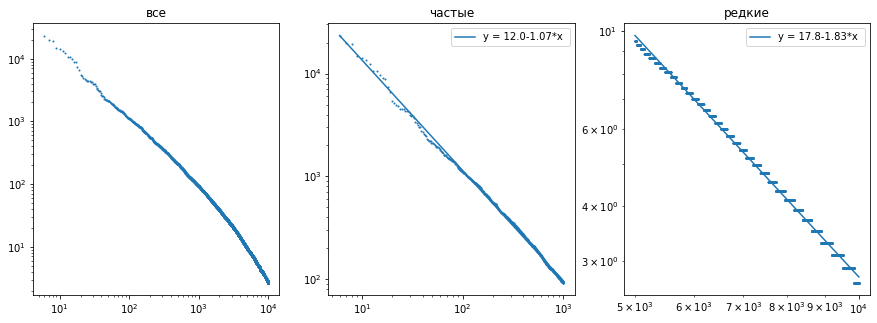
Word frequencies, as expected, obey Zipf's law.
For the first 1000 words, frequency decreases as $i^{-1.07},$
where $i$ is the serial number
in order of decreasing frequency. For rarer words, frequency decreases faster.
Below on the graphs in logarithmic scale (on both axes) the dependence $\mathrm{pm}(i)$ is drawn: