
Large Language Models (LLMs) are too big for consumer hardware, requiring GPUs with large VRAM. Quantization is a key technique to make LLMs smaller, improving efficiency and reducing memory usage.

Real-time water quality monitors with AI help assess immediate risk of illness from bacteria in southern England's swimming spots. Wessex Water's sensors accurately predict high bacteria levels 87% of the time at pilot study site Warleigh Weir.

Researchers from MIT and ETH Zurich developed an AI model to identify different stages of DCIS from breast tissue images, potentially streamlining diagnosis and treatment. By analyzing the spatial organization of cells, the model could help clinicians predict which DCIS cases may progress to invasive cancer, paving the way for more efficient and personalized care.

AI advancements are both thrilling and alarming. Screenwriter tests AI for screenplay, AI suggests improvements. Novel outdated in AI era.

LightGBM used for anomaly detection in Autoencoder class. Models predict values based on other columns to identify anomalies.

Ireland's datacentres consumed more electricity than urban homes in 2022, raising concerns about climate targets. The country's datacentres used 21% of its electricity, a 20% increase from the previous year, per the Central Statistics Office.

Protecting personally identifiable information (PII) is crucial for consumer trust. Amazon Lex and CloudWatch offer solutions to detect and mask sensitive data, reducing the risk of exposure in logs and transcripts.

AI and accelerated computing by NVIDIA are enhancing energy efficiency across industries, recognized by Lisbon Council Research. Transitioning to GPU-accelerated systems can save over 40 terawatt-hours of energy annually, with real-world examples like Murex and Wistron showcasing significant gains in energy consumption and productivity.

Runway's Gen-3 Alpha text-to-video synthesis model creates HD clips from prompts. It excels at mixing concepts but struggles with generalization beyond training data.

Generative AI poses a threat to public discourse and political accountability, as demonstrated by the recent AI-generated video of Steven Miles on TikTok. The uncanny features and unsettling details of the video highlight the ongoing concerns about the use of deepfakes in politics.

MIT researchers propose evaluating large language models based on alignment with human beliefs. Misalignment can lead to unexpected failures, especially in high-stakes situations.

Researchers at the University of Hull developed a method to detect AI-generated deepfake images by analyzing reflections in human eyes. This technique utilizes tools from astronomy to scrutinize the consistency of light reflections in eyeballs, potentially revolutionizing deepfake detection.

Samsung's Z Flip 6 debuts with enhanced battery, camera, screen, and AI features, making it a compact clamshell powerhouse for 2024. The sleek folding phone boasts a faster chip, longer battery life, and top-tier specs, including a 6.7in FHD+ 120Hz AMOLED display and Qualcomm Snapdragon 8 Gen 3 processor.
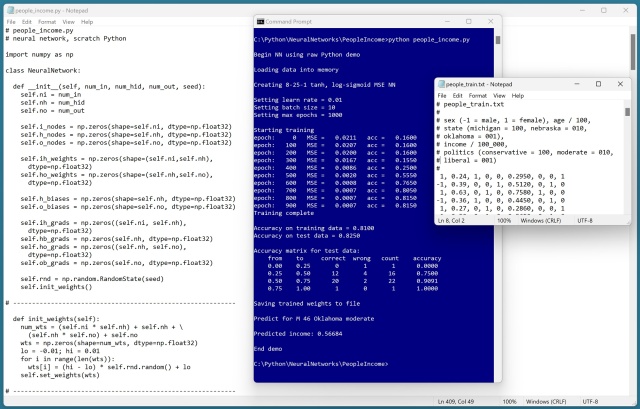
Neural network implementation for predicting income based on demographic data is complex but rewarding. Data encoding, training process, and network creation are crucial steps in achieving accurate predictions.

AI tools revolutionize weather forecasting by analyzing data patterns over years for accurate and faster predictions. Traditional methods rely on complex equations and grid replication of the atmosphere, while AI forecasts focus on long-term data analysis.