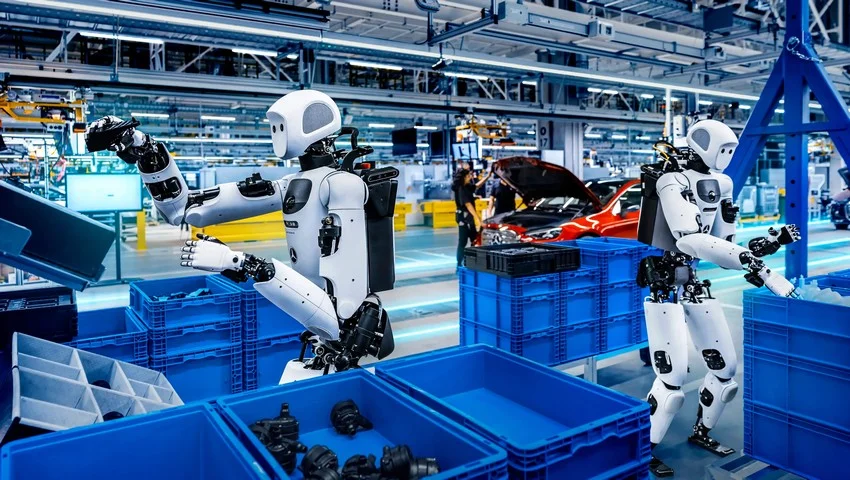
96% success! Humanoid robots take on factory tasks
Gemini Robotics 2.5 is the most advanced vision-language-action (VLA) model to date from Google DeepMind and designed to help robots perform a wider range of physical tasks with greater dexterity, reliability, and safety. The new model aims to bring AI-powered robots beyond controlled laboratory environments and closer to practical applications in manufacturing and everyday settings.
Gemini Robotics 2.5 builds on Google’s previous robotics research, expanding the ability of machines to understand their surroundings, manipulate objects, and adapt to unfamiliar situations. Its capabilities were evaluated across more than 200 distinct tasks, demonstrating improvements in both task complexity and execution speed.
One of the main advances in Gemini Robotics 2.5 is its ability to handle delicate objects and perform tasks that require precise movements and coordination. These include using everyday tools, manipulating flexible materials, handling fragile items, and completing multi-step operations.
According to Google DeepMind, the model achieves a 30% to 100% higher task success rate compared with previous baselines, depending on the task, while completing operations 20% to 30% faster.
The improvements were demonstrated in activities such as serving food with tongs, tying ribbons, folding clothes, and handling small components. Unlike traditional robotic systems designed for narrowly defined operations, the new model aims to help robots generalize their skills to different objects and environments.
Gemini Robotics 2.5 also supports different robotic platforms, including humanoid robots and systems equipped with specialized robotic arms and grippers.
A particularly notable demonstration involved a collaboration between Google DeepMind, robotics company Apptronik, and Mercedes-Benz.
The partners tested Apptronik’s Apollo 2 humanoid robots on active automotive production lines in Germany and Hungary. Using Gemini Robotics 2.5, the robots autonomously performed automotive kitting – sorting individual metal components from bulk containers and placing them into organized trays in the correct sequence for vehicle assembly.
The system combines two AI capabilities: Gemini Robotics ER, which handles spatial reasoning and workflow planning, and Gemini Robotics 2.5, which translates these decisions into physical actions by controlling the robot’s hands and arms.
The pilot achieved a 96% success rate, demonstrating the potential of AI-powered humanoid robots to perform repetitive and physically demanding industrial tasks. Automating such operations could help maintain production efficiency while allowing human technicians to focus on more complex work.
Gemini Robotics 2.5 introduces enhanced safety mechanisms that use reasoning during inference to help robots identify and avoid physical hazards in real time. According to Google DeepMind’s evaluations, these improvements increased safe task completion by 33% around obstacles and 43% around nearby people.
Google is also addressing security risks associated with autonomous robotic systems. The company introduced ASIMOV-Jailbreak, an open-source benchmark designed to evaluate whether robots can resist manipulated instructions that attempt to make them perform unsafe actions.
The benchmark includes hundreds of adversarial prompts covering different scenarios. Google reports that its Gemini 4 Argon model achieved 99.5% resistance to these attempts, compared with 82% for the previous Gemini Robotics ER 2 baseline.
Another important development is the role of Google’s Gemini 4 Argon in accelerating the development of robotics systems.
Training robots to perform new physical tasks traditionally requires extensive real-world demonstrations and large amounts of specialized data. Gemini 4 Argon helps address this challenge by generating simulated training scenarios based on real-world camera footage and creating digital twins of physical environments.
Researchers can use these simulations to generate thousands of practice scenarios, test different approaches, and analyze why particular actions fail. The results can then be used to improve robot performance both in simulation and on physical hardware.
Combining simulated training with real-world demonstrations could make it faster and more efficient to develop robotic systems capable of adapting to unfamiliar objects and environments.
Synthetic data generation is also becoming an important part of modern AI development, helping researchers and businesses overcome data limitations and improve model performance. QuData provides synthetic data generation solutions, including dataset creation, annotation, quality validation, data augmentation, and integration of synthetic and real-world data to support scalable AI model training.