NVIDIA opens Alpamayo 2 Super for commercial use
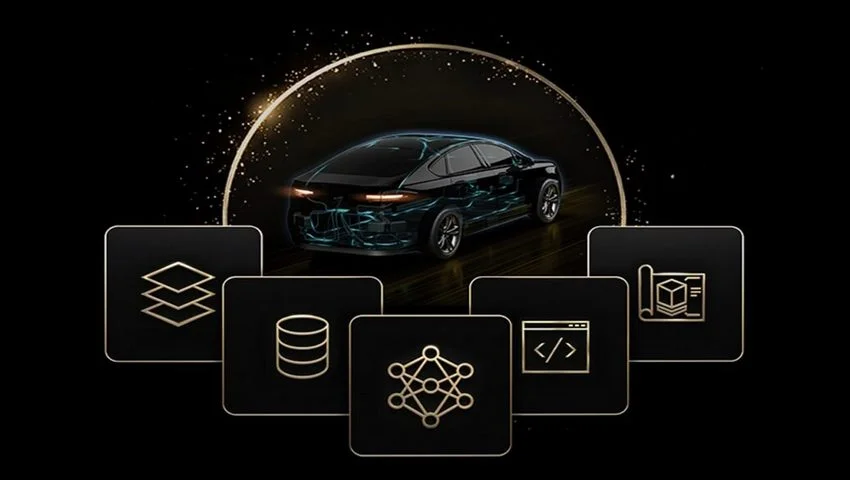
NVIDIA has made Alpamayo 2 Super, its latest open AI model for autonomous driving, available for commercial use. The 34-billion-parameter model is designed to help developers build Level 4 autonomous vehicles and robotaxis by combining visual perception, reasoning and driving actions in a single system.
Unlike traditional autonomous-driving systems that primarily detect objects and predict their movements, Alpamayo 2 Super is designed to reason about complex situations and explain the decisions it makes. Architecturally, it combines two components: a 32-billion-parameter vision-language model called Cosmos 3 Super Reasoner, which interprets the scene, and a smaller, roughly 2-billion-parameter “Action Expert” that converts that understanding into an actual driving path. It can process a 360-degree view from up to seven cameras and determine how the vehicle should respond to situations such as lane changes, merges, and difficult intersections.
For each driving situation, the model produces several linked outputs:
- Driving trajectory – the path the vehicle should follow.
- Reasoning trace – an explanation of the factors behind the decision.
- High-level action – such as stopping, yielding or changing lanes.
- Auto-labels – structured information that can be used to train other AI models.
- Visual answers – responses about objects and events in the scene linked to specific image regions of the camera images.
This makes the model useful not only for controlling autonomous vehicles but also for developing and evaluating other driving systems. For example, developers can use Alpamayo 2 Super to analyze real-world driving data, generate labels and create training material for smaller models designed to run directly inside vehicles. NVIDIA says the model can also help reduce the time required to annotate autonomous-driving data, potentially turning a process that can take months into one that takes days.
According to NVIDIA’s own testing, Alpamayo 2 Super scored 79.2 on LingoQA, a widely used driving-reasoning benchmark, ranking first among 37 evaluated models – ahead of Qwen2.5-VL 72B, Qwen3-VL 32B, Gemini 2.5 Pro, and GPT-4o. On trajectory prediction, it recorded a 0.911-meter average error over a 6.4-second horizon across more than 1,400 challenging driving samples, and it scored 0.433 on NVIDIA’s internal AV reasoning benchmark.
The model is also evaluated in closed-loop simulation, using NVIDIA’s AlpaSim framework, where its driving decisions affect what happens next in the simulated scene rather than being compared against a fixed, prerecorded outcome. This is a more demanding test, since it can reveal problems – like collisions or near-misses – that only emerge once the model’s actions start changing the environment around it.
These results are promising, but they come from NVIDIA’s own evaluations, and strong benchmark performance does not by itself demonstrate that a model is ready to safely operate autonomous vehicles in the real world. Autonomous driving remains a safety-critical problem, particularly when dealing with the rare, unpredictable situations that are hardest to test for.
One of the most significant aspects of the release is licensing. Alpamayo 2 Super is available under OpenMDW-1.1, a permissive Linux Foundation license that allows companies to fine-tune the model, build derivative models, and use them commercially without seeking further permission from NVIDIA. Earlier Alpamayo models were licensed mainly for research; NVIDIA has now extended the same open commercial terms across its entire model family, not just this latest release. This gives automakers, autonomous-driving companies, and suppliers the ability to adapt the technology to their own data and driving systems while keeping control of their proprietary fleet data.
NVIDIA is releasing an ecosystem around the model, including AlpaSim for simulation, AlpaGym for closed-loop reinforcement learning, and open physical AI datasets for training and evaluation. Together, these tools are meant to support the full development process – from collecting and labeling driving data to training, testing, and deploying autonomous-driving models.
Rather than expecting the full 34-billion-parameter model to run directly in every vehicle, NVIDIA envisions a cloud-to-car workflow. Alpamayo 2 Super acts as a powerful “teacher” during development, generating reasoning traces and training data that are then used to create smaller, more efficient models suited to real-time deployment on in-vehicle hardware such as NVIDIA’s DRIVE AGX Thor. Lighter models in the family, Alpamayo 1.5 and Alpamayo 1, remain available for teams that don’t need the full model’s reasoning power.
With Alpamayo 2 Super, NVIDIA is betting that open, explainable reasoning models – combined with simulation and large-scale training data – can help move autonomous driving from research prototypes toward scalable commercial deployment.
Model weights are available now on Hugging Face, with inference notebooks published on GitHub for developers who want to test trajectory generation, meta-action prediction, scene question-answering, and auto-labeling directly.