China’s Robot Olympics: record-breaking speed & spectacular fails
The 2026 World Humanoid Robot Games in Beijing have become a striking demonstration of both the progress and limitations of physical AI. The five-day competition brings together 2,056 robots from 666 teams representing 16 countries for 51 events at the National Speed Skating Oval. Alongside athletic competitions, the Games test robots in table tennis, weightlifting, football, precision manipulation, and scenario-based tasks designed around real-world environments.
The event has produced spectacular athletic results. Tiangong Ultra, developed by the Beijing Humanoid Robot Innovation Center, set a new 100-meter record of 8.86 seconds, surpassing both its earlier 9.39-second mark and Usain Bolt’s 9.58-second human record. The machines have also surpassed human records over longer distances. Tiangong Ultra has been reported to complete the 400 meters in 38.15 seconds, compared with Wayde van Niekerk’s 43.03-second world record, and the 1,500 meters in 2 minutes 21.64 seconds.
Yet the most revealing moments have often come immediately after the records. The fastest robots have struggled to decelerate smoothly, with machines crashing into padded barriers after crossing the finish line. These incidents highlight a fundamental distinction in robotics: achieving impressive peak performance is very different from maintaining stable, safe and predictable behavior in the physical world.
The Games therefore extend well beyond running and jumping. Robots are competing in table tennis, football, weightlifting and other sports, while scenario-based events reproduce tasks in factories, hotels, hospitals, homes and retail environments. These challenges test capabilities that matter much more for practical deployment: recognizing objects, manipulating them precisely, recovering from mistakes and completing multistep tasks in less controlled environments.
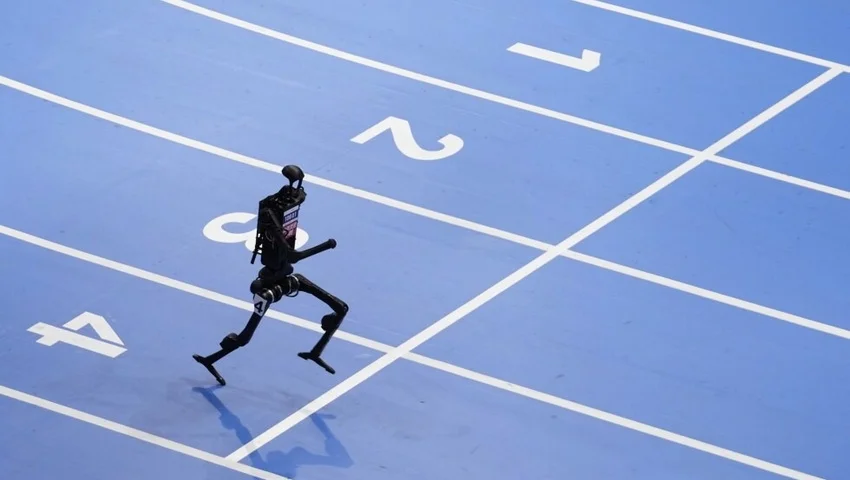
In the 400-meter small-group final, X-Humanoid’s Tien Kung Omni won gold in 45.66 seconds using an unusual running posture. Engineers had initially designed the robot around a human-style arm swing. During reinforcement-learning training, however, the policy abandoned that approach and discovered a different solution: the robot ran with its arms raised close to its face, its torso pitched forward, and much of the propulsion coming from its hips and waist.
The behavior was not explicitly programmed by the engineers. According to X-Humanoid engineer Han Gang, it emerged during training in simulation. The reported reward objective emphasized completing the 400 meters quickly without prescribing a particular arm position. The simulation accounted for physical constraints including thermal stress on the shoulder joints, allowing the policy to discover that keeping the arms raised could reduce shoulder loading while shifting more of the work toward the robot’s stronger lower-body mechanisms.
What makes the example particularly interesting is that the behavior successfully transferred from simulation to the physical robot. This is a practical demonstration of the sim-to-real problem at the heart of modern robotics: a policy must not only perform well in a simulated environment but also remain effective when confronted with the mechanical, thermal and dynamic constraints of real hardware.
The result also illustrates an important advantage of reinforcement learning. Rather than prescribing every movement, engineers can define an objective and allow the system to explore different strategies within the constraints of the robot. The resulting behavior may look strange from a human perspective, but it can reveal solutions that would be difficult to design manually.
The Games’ rules reflect the same shift from demonstration to autonomy. More than 40% of the competition’s tests require full autonomous operation, while other events still allow teleoperation. The distinction is particularly important in scenario-based tasks, where the ability to perceive an environment, make decisions and recover from errors can matter more than raw physical speed.
This is where the World Humanoid Robot Games become more than a spectacle. Running faster than a human is an impressive benchmark, but industrial deployment requires something harder: reliable perception, adaptive control, dexterity, safe interaction and the ability to complete useful tasks without constant human intervention.
The 2026 Games show that humanoid robots are making rapid progress on some of these challenges. At the same time, their falls, collisions and failures make the remaining gap visible. The next stage of physical AI will not simply be about making robots faster or stronger – it will be about making them more autonomous, adaptable and reliable in the unpredictable physical world.