
Casual art without illusions: what AI can actually do
The gamedev industry is evolving faster than ever. Not long ago, discussions about artificial intelligence revolved around whether it could replace human creators. Today, that focus has shifted. AI is no longer a philosophical debate – it has become a tool of competitive advantage.
We have already explored why AI is no longer optional in modern game development and shared some hands-on (and occasionally amusing) experiences in our article “No eyes please! – How we taught AI to be a game designer”. Now it is time to figure out how AI is actually integrated into real production pipelines, specifically in casual game art.
While AI is increasingly used in graphics production, its true value only becomes clear when you understand the limits of these tools. Based on the experience of the Absolutist art studio, we’ll take a close look at Leonardo AI to identify where AI genuinely saves time and adds value, and where manual artist work remains essential.
General principles of working with Leonardo AI
To achieve results that closely match the desired visual style, we recommend uploading references into an AI chat (for example, ChatGPT) and asking it to describe the style clearly and precisely – specifically tailored for Leonardo AI. This approach significantly improves the relevance and consistency of generated content. The results are limited only by the user’s creativity and skill level: from logos and collectibles to isometric maps, game interfaces and backgrounds.
Leonardo AI as a rapid kickoff tool
The main value of Leonardo AI lies in accelerating the early stages of production. It excels at rapid ideation – exploring silhouettes, camera angles, color palettes, and overall mood for scenes or characters. Instead of lengthy manual sketching or reference gathering, artists can quickly generate multiple visual directions and determine the most promising path forward.
But with so many available tools, which one actually performs best? To find out, we deliberately assigned the AI a complex task using the following prompt:
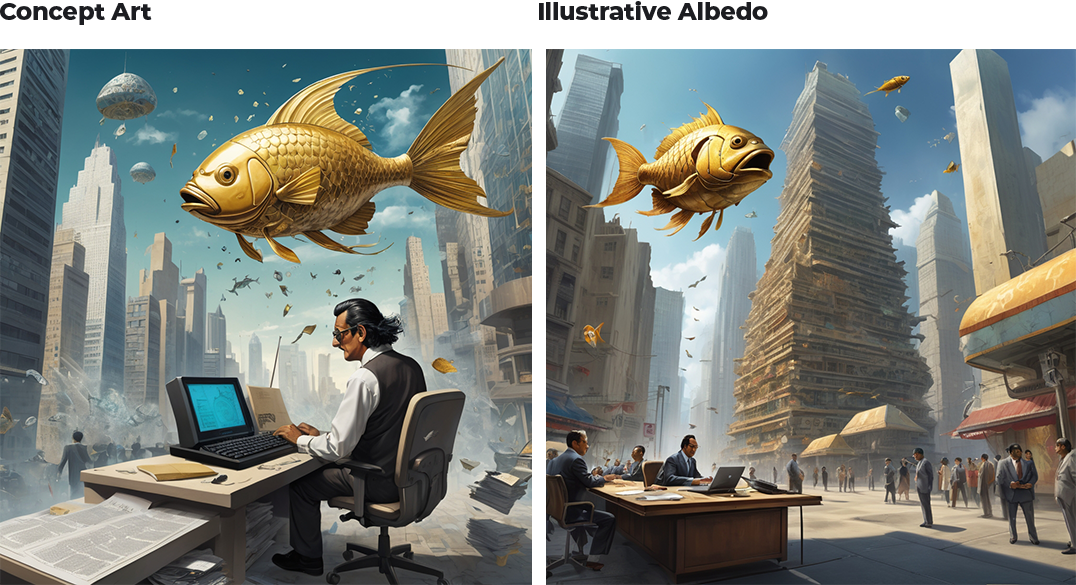
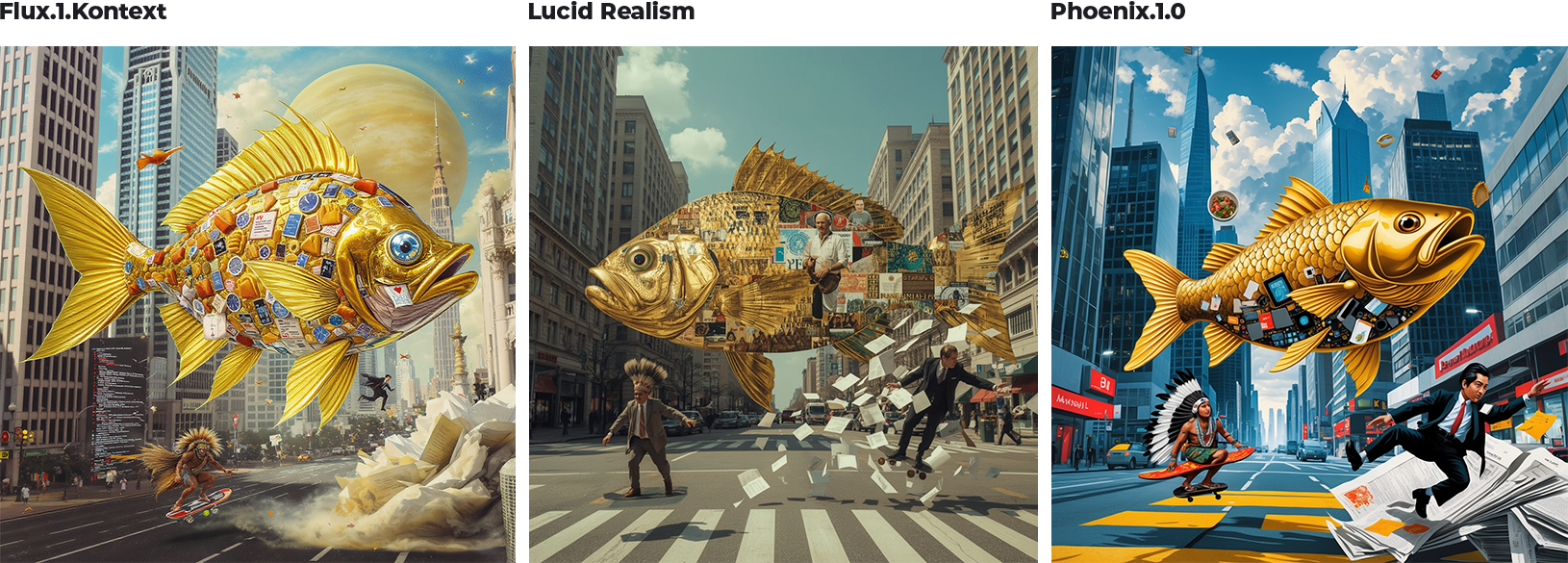
“Surreal romantic art inspired by Salvador Dalí and Yoshitaka Amano. Amidst the streets of a sprawling metropolis and tall skyscrapers, a giant golden surreal fish flies by day. The fish is a collage of software code, fragments of digital art, document icons, electronic clocks, and fast food. Below, a Mayan Indian flies on a keyboard like a skateboard, while on the other side, a whirlwind of documents follows a banker on the briefcase.”
The standard Concept Art and Illustrative Albedo modes completely failed to handle the task.
However, we didn’t give up. We experimented with available modes like Flux.1.Kontext, Lucid Realism, and Phoenix.1.0. These were much closer to the prompt – all plot elements were present – but they failed to merge into a single, harmonious composition.
Finally, we applied the newest tool Nano Banana/Nano Banana Pro. The result was impressive – a full-fledged concept that could actually be taken further into production.
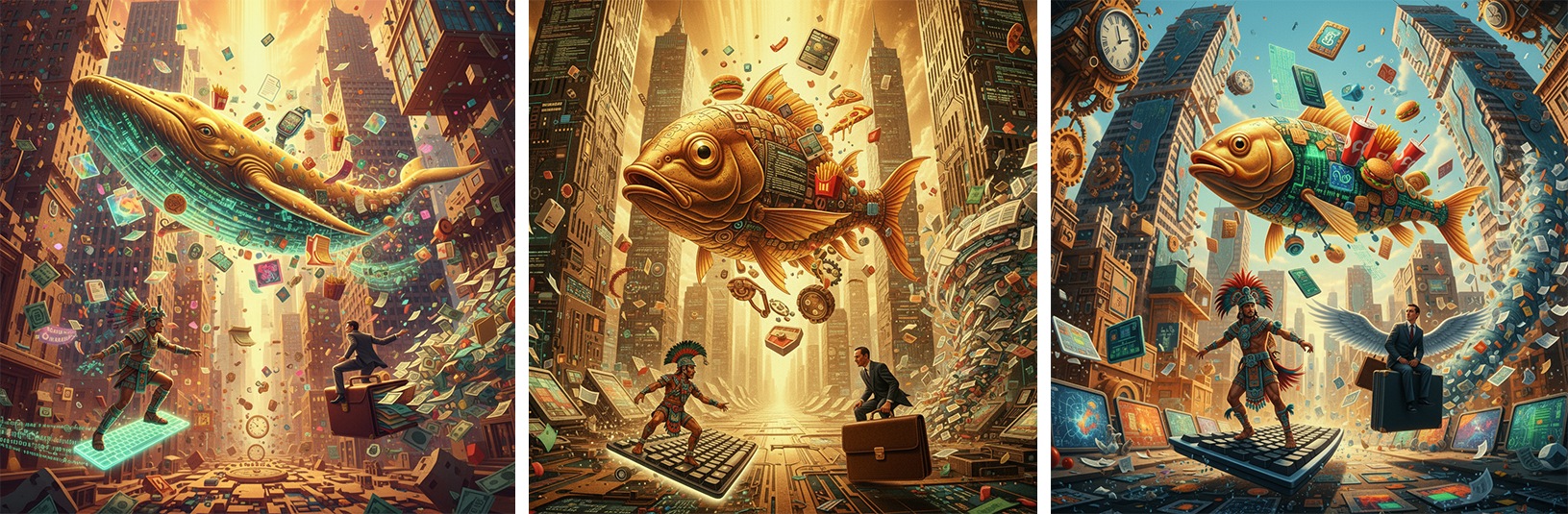
Our conclusion: The Nano Banana mode currently performs best for concept art, combining logical structure with creative interpretation. Its only current drawback is high token consumption.
Working with backgrounds
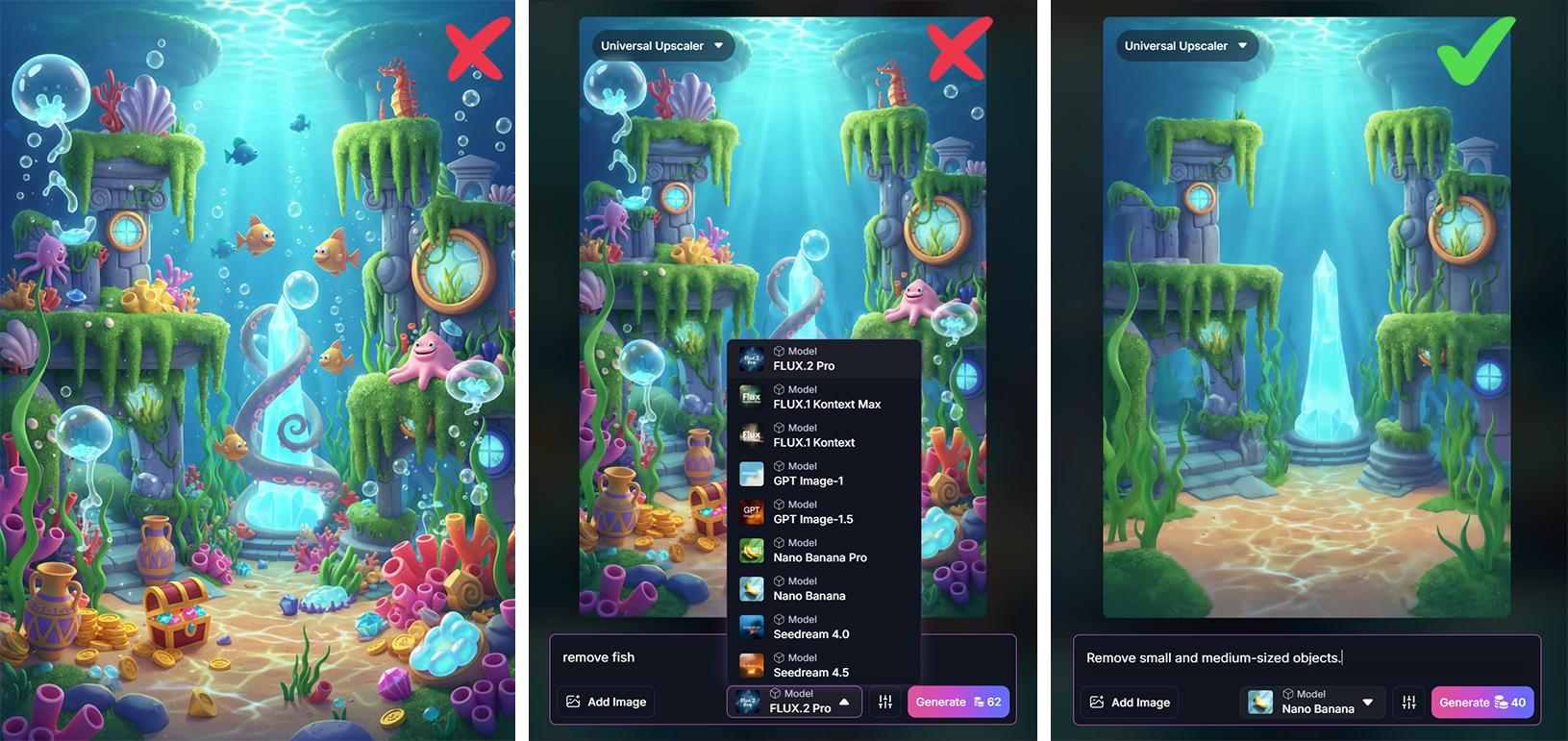
Leonardo AI is capable of producing high-quality backgrounds using both abstract and highly detailed prompts. It performs particularly well in conveying atmosphere (emotional tone, tension, calmness, and drama), lighting, and the overall scene composition.
The generation process mirrors concept art workflows, so you should follow the same initial tips. When adjustments are needed, artists can revisit their image library, open a selected image, and specify changes in the editing window. For example, removing unnecessary details, UI elements, or visual noise often yields a cleaner, more production-ready result.
Character generation
When developing character concepts, it is best to request at least 6-8 variations per prompt, as AI often duplicates poses with minimal changes. Batch generation in a single format typically produces better results than iterating on a single image. Prompts benefit from including: dynamic poses or actions, emotional states, additional props, background color (useful for later cutouts in Photoshop), etc.
You can also “re-dress” characters or create variations in different poses, actions and moods using Image Reference. To generate additional poses, upload the base character image as a reference. While Leonardo doesn’t always “catch” the reference on the first try – sometimes producing completely unrelated results – persistence pays off. Usually, repeating the action (up to 6 times) leads to the desired outcome. For instance, when asking to change a sweater’s color to green, the AI might only fulfill the request on the second attempt.
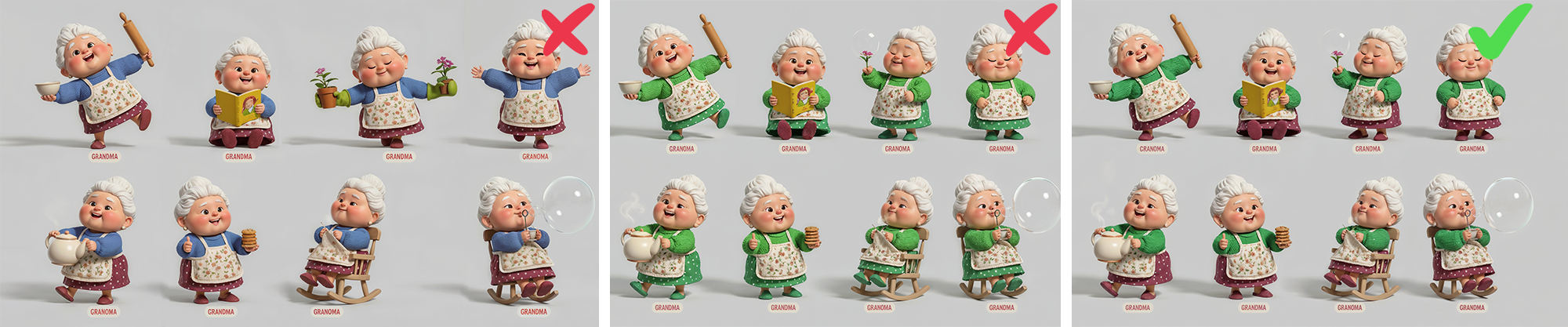
Generating pose variations based on characters created outside Leonardo is also feasible. By uploading your character into Image Reference, you might find that the first few (in our case 3) generations miss the mark stylistically, but by the fourth attempt (even without changing the prompt), the match can be near-perfect.
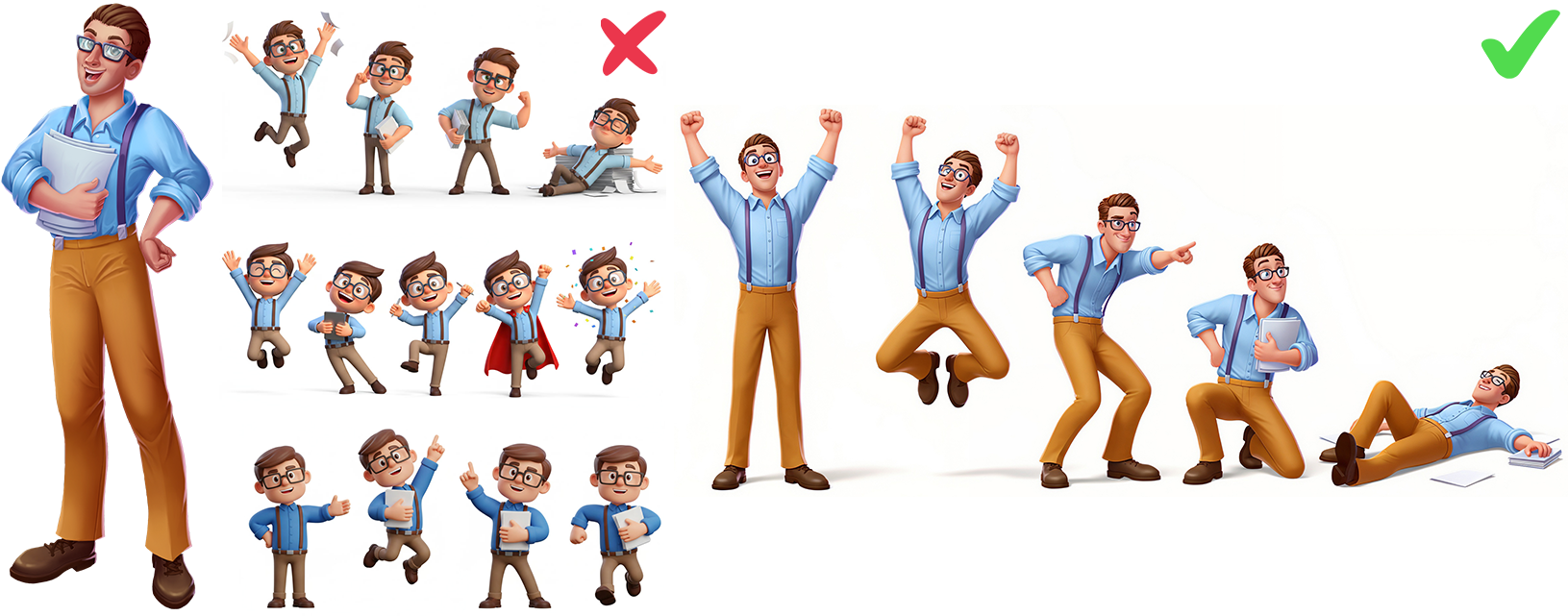
That said, final images almost always require manual cleanup due to artifacts and stylistic inconsistencies.
UI creation with Leonardo AI
Leonardo AI is effective for generating UI art, allowing teams to create entire screens or windows tailored to specific game genres (match-3, hidden object, mahjong, etc.). With detailed prompts and references, it produces stylized panels, menus, and backgrounds that match a game’s theme: from whimsical fairy tales to dark fantasy.
However, full UI screens often suffer from layout issues: misaligned icons, inconsistent spacing, and poorly structured navigation elements. These problems require manual correction in Photoshop.
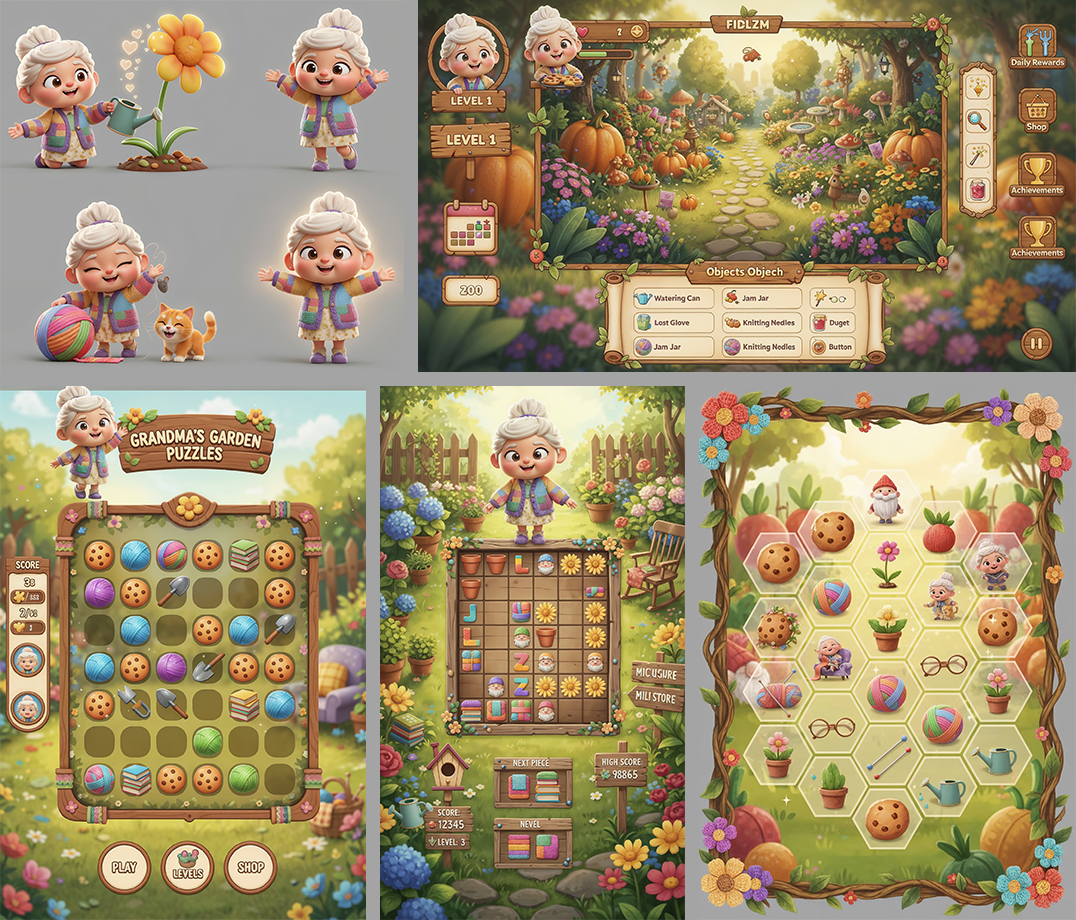
A more effective approach is generating individual asset sets: buttons, icons, progress bars, frames. Similar to character generation, it is best to create multiple items (like frames) at once. Use prompts like: “multiple variants, separate layout, gray background, game asset, theme, material, visual style (e.g., casual, 3D render, cartoon)”.
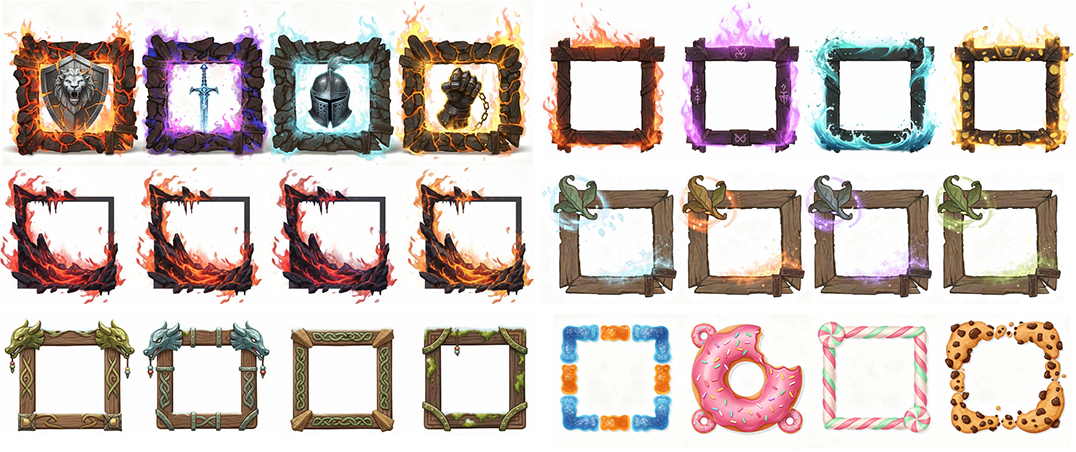
The Upscaler tool significantly improves detail quality, after which assets can be integrated into prototypes. This accelerates the casual game pipeline, but for commercial stability, AI-generated art must be combined with post-processing to ensure stylistic consistency and usability.
The challenge of style consistency
The biggest challenge when working with Leonardo AI is maintaining a stable casual style. Even with precise prompts, outputs may drift toward excessive cartoonishness or semi-realism.
The Nano Banana model currently performs best in casual aesthetics, especially when using stylistic references, but it still does not guarantee consistent results on the first attempt.
Stable Diffusion as an alternative
For large-scale projects, training a custom Stable Diffusion model tailored to a specific style can be a viable solution. This approach offers greater consistency but requires additional technical expertise, time, and resources.
Why artists are indispensable
AI-generated images almost always contain anatomical inaccuracies, proportion errors, over- or under-detailing, blurred or broken areas. Final artwork is typically assembled from multiple generations, manually composited and refined. The artist remains ultimately responsible for the clean render and the unity of style.
Integrating AI into a casual art pipeline is not about pressing a “make it beautiful” button, nor is it about replacing creativity. It is an iterative process where the artist evolves from an executor to an Art Director for the neural network, controlling the style, quality, and relevance of every output.
In practice, AI excels where speed matters most: concepting, prototyping, visual exploration, color palette development, and secondary asset generation. Meanwhile, final rendering, anatomical accuracy, compositional integrity, and UI usability remain firmly in human hands. Without manual refinement and post-processing, a stable commercial product is currently unattainable.
Even the most capable models, such as Nano Banana, deliver impressive results but still require an experienced eye to maintain visual consistency across an entire game. Ultimately, the quality of the final product depends on the balance between AI capabilities and human expertise.
Absolutist art studio team