
Artificial neuron brings robots closer to human-like awareness
In a significant advancement toward human-like intelligence in machines, scientists have engineered a single artificial neuron capable of performing the functions of multiple brain regions. This development could enable robots to perceive, learn, and act with adaptability and responsiveness previously thought exclusive to living brains.
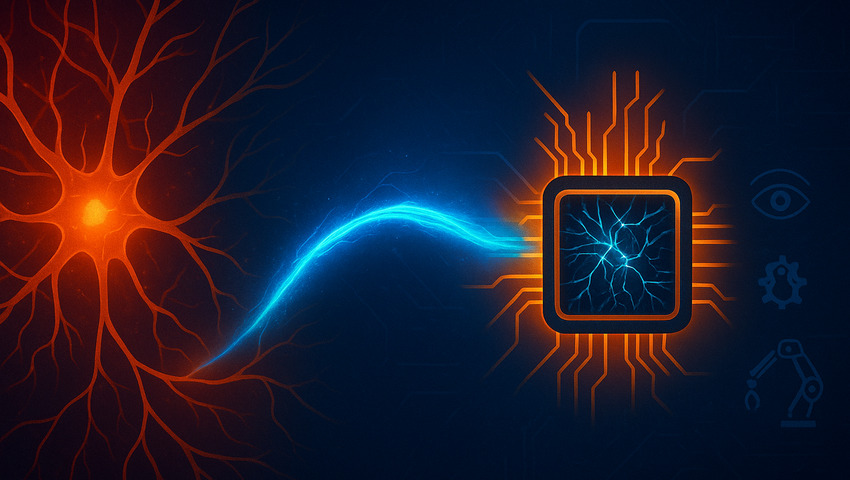
The device, dubbed a transneuron, can switch roles between brain cells involved in vision, planning, and movement. Developed by an international team led by Loughborough University, with collaborators from the Salk Institute and the University of Southern California, the transneuron represents a major leap for neuromorphic computing – technology designed to replicate the brain’s efficiency and flexibility in hardware.
Traditional artificial neurons typically perform a single, narrowly defined function, requiring large networks to handle even basic tasks. The new transneuron breaks that limitation.
By finely adjusting its electrical settings, a single unit can reproduce neural firing patterns from three distinct brain regions, achieving 70-100% accuracy. These ranged from steady pulses to rapid bursts, closely mirroring the variability of biological neurons.
Beyond mimicking neural activity, the transneuron performs core computational functions. The device changes its firing rate based on input signals and responds differently when two signals arrive together versus out of sync – an ability known as temporal coding. Typically, replicating this requires multiple artificial neurons working in tandem.
This capability is made possible by a nanoscale component called a memristor. Silver atoms within the memristor shift as electricity flows, forming and breaking conductive bridges that allow the device to retain memory of past signals and adapt its response, similar to synaptic plasticity in the brain. Changes in voltage, resistance, or temperature further tune the neuron’s behavior without software intervention.
The next step involves integrating networks of transneurons to create a “brain cortex on a chip.” Such systems could form the foundation of artificial nervous systems for robots, enabling real-time perception, adaptation, and learning. These networks promise continuous, energy-efficient learning and dynamic responses, overcoming limitations of current AI systems.
The technology could eventually interface directly with the human nervous system, offering new tools for studying neural communication, treating neurological disorders, or even augmenting brain function. Transneurons could serve as experimental platforms to study neural communication or explore the emergence of consciousness in controlled environments.
Published research signals a shift in artificial intelligence from software that simulates brain function to hardware that behaves like it. With its ability to adapt, compute, and switch roles on demand, the transneuron may become a building block for future self-learning robots and next-generation computing systems that operate with the efficiency and flexibility of biological brains.