
Claude Cowork – your new AI employee
In a move that marks the transition from chatbots that talk to agents that do, Anthropic has officially unveiled Cowork.
Built directly into the Claude macOS desktop app, Cowork is a “research preview” designed to give non-technical users the same autonomous power previously reserved for software engineers using Claude Code. By granting the AI access to specific local folders, users can now delegate multi-step administrative and creative tasks that Claude executes independently on their machine.
For the past year, the industry has buzzed about “agentic AI” – systems that can plan and act without constant human hand-holding. With Cowork, Anthropic is making this a consumer reality.
Unlike a standard chat interface where you must manually upload files and wait for a response, Cowork functions as a background collaborator.
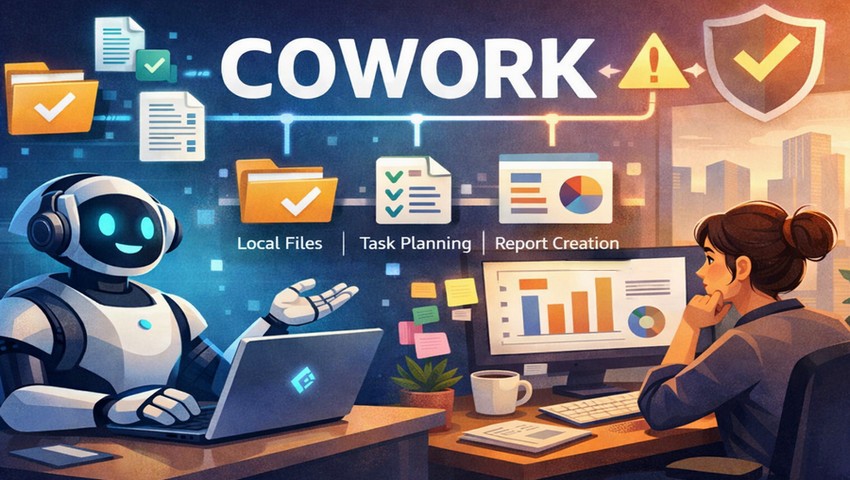
- Local File Access: Users “mount” a specific folder. Claude can then read, edit, and create files (Excel, PDFs, Word docs) within that directory.
- Autonomous Planning: Instead of just summarizing a document, you can give a high-level goal. For example, you could point Claude to a folder of 20 raw interview transcripts and say: “Identify the top five recurring themes across these interviews, draft a branded slide deck in a new folder summarizing the findings, and create a CSV file with direct quotes for each theme.”
- Parallel Execution: While traditional Claude chats are linear, Cowork can queue and run tasks in parallel, allowing it to handle “long-horizon” work that might take 30 minutes or more to complete.
Interestingly, Anthropic revealed that Cowork was born out of user behavior. After the release of Claude Code (the company’s CLI-based developer tool) in late 2024, Anthropic noticed that users were struggling with the command line just to use the agent for non-coding tasks like organizing files or analyzing spreadsheets.
However, Anthropic is explicit about the risks associated with more autonomous AI behavior. Because Cowork can take potentially destructive actions, such as deleting files, the company stresses the importance of clear, unambiguous prompts. Anthropic also reiterates the ongoing industry-wide challenge of prompt injection attacks, particularly when agents interact with external content. While safeguards are in place, agent safety remains an active area of development.
To mitigate these concerns, Cowork operates under strict user-defined permissions: Claude can only access folders and connectors explicitly approved by the user, and it requests confirmation before taking significant actions. These controls, combined with the research-preview status, reflect Anthropic’s cautious approach as it gathers feedback and real-world usage data.
Looking ahead, Anthropic plans rapid iteration on Cowork, with potential improvements including cross-device sync, Windows support, and enhanced safety mechanisms. For now, Cowork represents a strategic step in Anthropic’s broader effort to position Claude not just as a conversational assistant, but as a practical, agentic collaborator for general computing and office work.
The launch of Cowork serves as a primary example of our 2026 forecast: a shift from individual AI usage to team and workflow orchestration. As predicted, 2026 marks the rise of the digital coworker. We are seeing a move away from systems that simply follow instructions toward agents that anticipate needs and execute workflows autonomously.