Drones are becoming too smart to crash
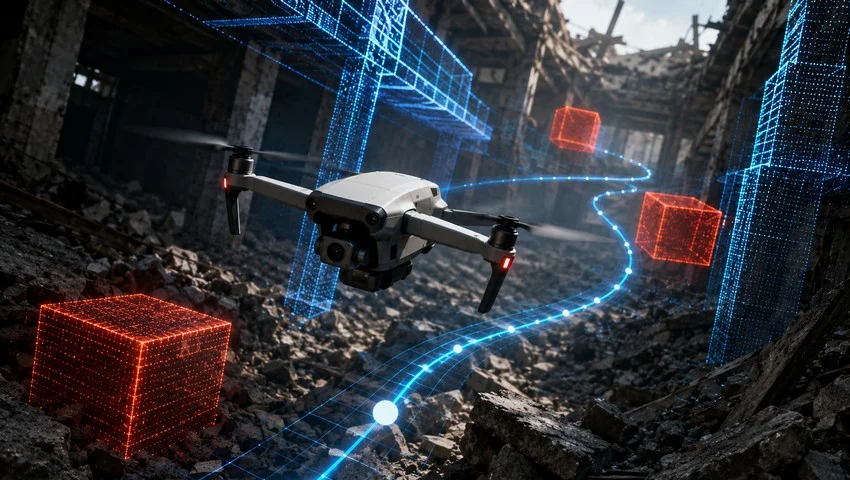
Autonomous drones are moving closer to operating effectively in some of the world’s most dangerous and unpredictable environments. Researchers from MIT and the University of Pennsylvania introduced MIGHTY, a new open-source trajectory-planning system that enables unmanned aerial vehicles to avoid obstacles in milliseconds while maintaining smooth, efficient flight paths. The development represents another important step toward intelligent drone systems capable of supporting disaster response, industrial inspection, and urban delivery operations with minimal human intervention.
Trajectory planning has long been one of the biggest challenges in autonomous robotics. UAVs operating in collapsed buildings, industrial facilities, or crowded urban areas must constantly balance speed, safety, and stability. Traditional planning systems often rely on fixed travel-time estimates before calculating a route, which can create limitations when unexpected obstacles appear. If a drone suddenly needs to detour around debris, wires, or moving objects, it may be forced to accelerate aggressively to stay on schedule, reducing overall flight safety.
MIGHTY addresses this challenge by optimizing both the flight path and travel time simultaneously. Instead of separating spatial and temporal calculations, the system uses Hermite splines to create smooth trajectories that can adapt dynamically as environmental conditions change. The approach allows drones to react almost instantly to new obstacles while maintaining stable and energy-efficient flight behavior.
One of the most important aspects of the project is its focus on real-time onboard computation. The system relies entirely on the drone’s onboard sensors and processors, using LiDAR-generated maps to continuously refine flight trajectories during operation. Rather than recalculating an entire route from scratch, MIGHTY begins with an initial trajectory estimate and iteratively improves it as new environmental data becomes available. This significantly reduces computational overhead while preserving fast reaction times.
The performance improvements demonstrated in testing highlight the potential impact of the technology. In simulation experiments, the system completed tasks using roughly 90 percent of the computation time required by existing state-of-the-art approaches while reaching destinations approximately 15 percent faster. Real-world flight tests showed UAVs navigating obstacle-filled environments at speeds of up to 6.7 meters per second without collisions.
Equally significant is the decision to release the system as open-source software. Advanced trajectory-planning solutions often depend on expensive proprietary solvers that limit accessibility for smaller research groups, startups, and humanitarian organizations. By removing those barriers, MIGHTY creates opportunities for broader innovation in autonomous robotics and UAV deployment.
The growing importance of intelligent drone navigation aligns closely with the work being carried out by QuData, a company focused on AI-driven technologies, including drone solutions. As autonomous UAV operations become more sophisticated, trajectory-planning systems like MIGHTY can complement QuData’s broader mission of developing advanced UAV technologies for high-risk and complex environments.
The future direction of MIGHTY also points toward broader industry trends. Researchers plan to expand the system for multi-robot coordination, allowing several autonomous drones to navigate and collaborate simultaneously in complex environments. This capability could play a critical role in large-scale disaster mapping, industrial inspections, and autonomous logistics networks where fleets of UAVs must safely operate together in real time.