
Smarter than ever? How AI agents are changing everything
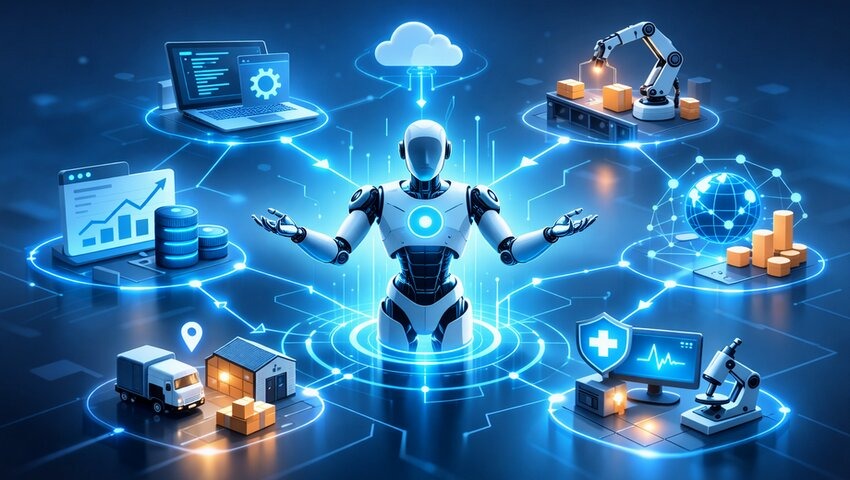
Artificial intelligence has evolved far beyond tools that simply answer questions or generate content. The next frontier is AI agents – autonomous software systems capable of reasoning, planning, learning, and acting independently to achieve goals. Unlike traditional AI models that require constant human input, AI agents operate with a high degree of autonomy, interacting with their environment and coordinating with other agents to tackle complex tasks. This shift is fueled by advancements in large language models (LLMs) like Anthropic's Claude Opus, and emerging agentic frameworks, enabling agents to handle everything from real-time inventory optimization to predictive healthcare diagnostics.
This evolution is transforming industries from software development to healthcare, finance, and logistics, driving automation, enhanced decision-making, and operational efficiency.
What are AI agents?
At their core, AI agents are intelligent systems designed to observe, reason, plan, act, and learn. They process diverse data types – text, voice, video, code, and sensor inputs – making them multimodal problem-solvers. Deployed individually or in multi-agent systems, they collaborate to address objectives too intricate for a single entity, such as orchestrating supply chain disruptions across global networks.
Key features include:
- Reasoning: Agents analyze data, spot patterns, and make decisions, often using chain-of-thought prompting to simulate human-like deduction.
- Acting: They execute actions digitally (e.g., API calls) or physically (e.g., via robotics), like automating code deployments.
- Observing: Through sensors, APIs, or user interactions, agents monitor environments in real-time.
- Planning: High-level goals are decomposed into subtasks, with foresight for obstacles using techniques like Monte Carlo tree search.
- Collaboration: Agents team up with humans or other agents to align on decisions.
Some agents also tend to self-refine. Drawing from past experiences, they iterate via reinforcement learning, boosting accuracy over time – for instance, refining fraud detection models based on false positives.
Unlike chatbots or assistants that await prompts, AI agents exhibit proactive autonomy, executing workflows and adapting to flux without oversight.
How AI agents work
AI agents harness LLMs, memory systems, and external tools in a cyclical workflow. Consider a three-stage process:
- Goal initialization and planning: Objectives are broken into subtasks. For complex scenarios, frameworks like ReAct (iterative reasoning and action) or ReWOO (reasoning without observation) enable multi-step foresight.
- Reasoning with tools: When internal knowledge is insufficient, agents can call on external resources: databases, APIs, or other agents – to fill gaps. This allows them to adapt and make more informed decisions.
- Learning and reflection: Agents store experiences in various memory types: short-term for immediate recall, long-term for patterns, episodic for narratives. Feedback from humans or other agents ensures that decisions align with intended goals, a process known as iterative refinement.
This integration allows agents to evolve, as seen in Google’s Concierge Agents that personalize user interactions by remembering preferences across sessions.
The following flowchart provides a clear overview of the AI agent’s workflow.
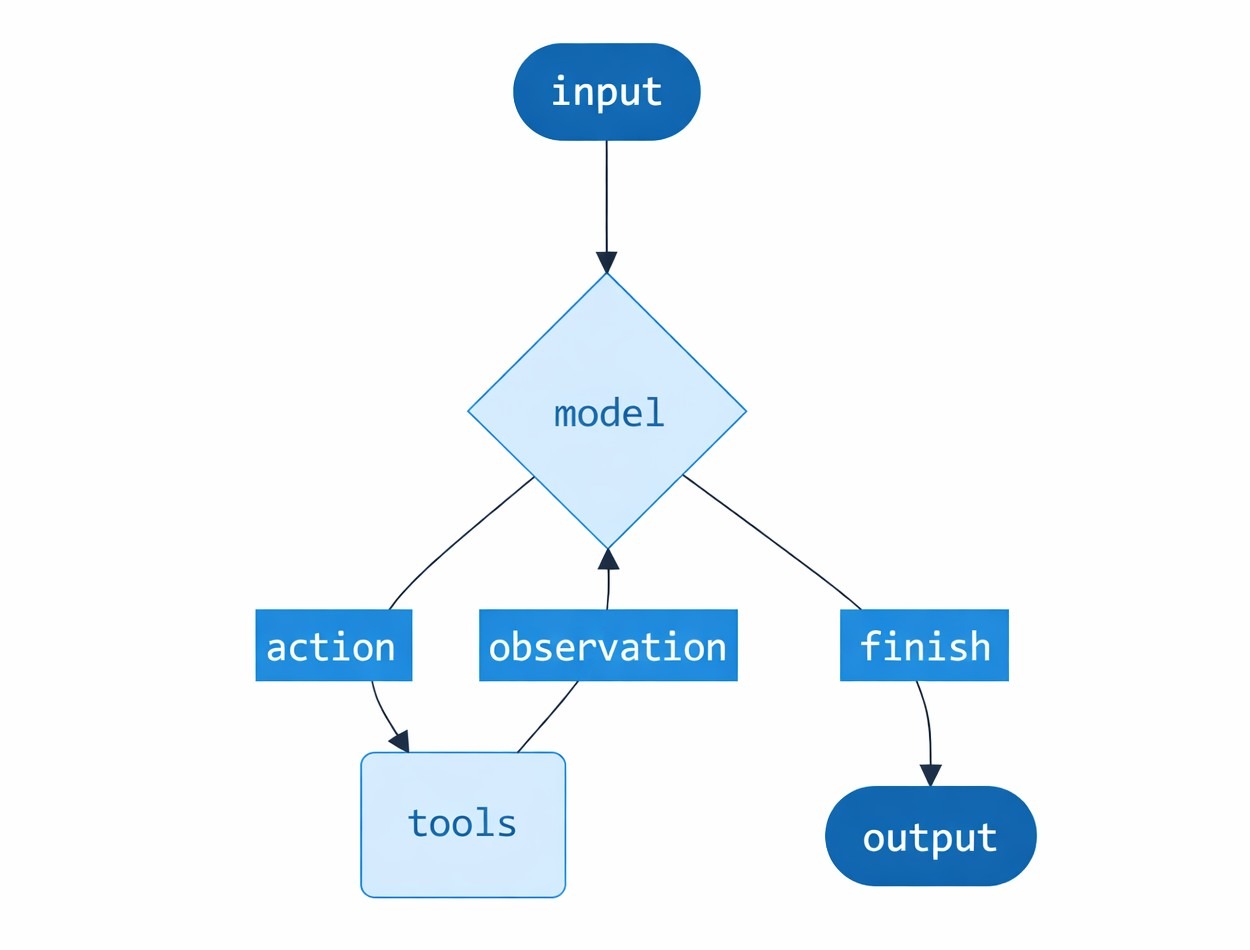
The architecture often includes Retrieval-Augmented Generation (RAG), structured prompting, and constraint layers designed to mitigate hallucinations and limit unintended behavior. Many developers today use open-source frameworks like LangChain or Microsoft’s AutoGen to orchestrate these complex interactions between different models and tools, rather than relying on a single monolithic model.
Types of AI agents
AI agents are highly versatile and can be classified according to their reasoning complexity and operational design:
| Type | Description | Best for | Example |
|---|---|---|---|
| Simple Reflex | Reacts to current inputs via rules; no memory | Predictable, observable setups | Basic chat filters for spam |
| Model-Based Reflex | Builds an internal world model for partial observability | Dynamic but structured environments | Traffic light optimizers |
| Goal-Based | Plans sequences to meet objectives | Targeted tasks | Delivery route planners |
| Utility-Based | Weighs outcomes for maximal reward | Trade-off scenarios | Resource allocators in finance |
| Learning | Evolves via data and feedback | Adaptive, long-term use | Personalized recommendation engines |
Agents can also be interactive (user-facing, like virtual assistants) or background (silent automators), and can function individually or within multi-agent systems for collaborative problem-solving.
AI agents in practice
AI agents are reshaping sectors with tangible impacts. Here are some interesting real-world examples from leading companies:
- Software Development: GitHub Copilot autonomously generates, debugs, and refactors code from natural language specs. Similarly, Anthropic’s Claude Code agents, powered by Claude Opus 4.6, enable multi-agent collaboration where 16 instances worked together to build a new C compiler from scratch, demonstrating advanced code orchestration. Cursor AI, another standout, integrates agentic workflows for end-to-end app development.
- Healthcare: PathAI’s agents claim to analyze pathology slides with more than 90% diagnostic accuracy, accelerating cancer detection and freeing pathologists for complex cases. Hippocratic AI’s clinical agents handle patient triage and virtual consultations, reducing wait times, while Qure.ai’s radiology agents detect anomalies in X-rays, aiding doctors in underserved regions. Meanwhile, QuData develops AI-powered solutions for breast cancer diagnosis, focusing on early detection and more precise clinical outcomes.
- Finance and Supply Chains: Amazon’s multi-agent systems on Bedrock can orchestrate logistics, detecting low stock, rerouting inventory, and notifying vendors in real-time. In finance, agents like those from Aisera monitor transactions for fraud, and Oracle’s AI agents can automate compliance checks and sales deal negotiations.
- Customer Experience: Dialpad’s agents handle resolutions autonomously, from query triage to fulfillment. Kore.ai’s conversational agents power enterprise chatbots for brands like Airbus, resolving about 70% of inquiries without human escalation through multi-turn reasoning.
- Personal Assistants: OpenClaw (formerly Clawdbot and Moltbot) is an open-source AI agent framework that runs locally on user devices and integrates with messaging apps like WhatsApp, Telegram, Slack, Discord, and Signal to perform proactive tasks such as clearing inboxes, sending emails, managing calendars, checking in for flights, and automating browser/file operations.
Benefits of AI agents
AI agents offer several significant advantages:
- Automation and Efficiency: Agents can operate continuously, taking on repetitive or complex tasks, freeing humans for creative or strategic work.
- Enhanced Decision-Making: Collaboration between agents and access to real-time information leads to better-informed choices.
- Scalability: Agents can work simultaneously on multiple tasks and scale with cloud-based infrastructure like Google Cloud Run.
- Improved Output Quality: AI agents learn from experience and feedback, delivering more accurate, personalized, and comprehensive results.
Challenges and risks
Despite their potential, AI agents introduce new challenges:
- Ethical and Social Limitations: Agents struggle with nuanced emotional intelligence, ethical judgment, and highly dynamic physical environments.
- Security and Data Privacy: Mismanaged agents could compromise sensitive information or introduce vulnerabilities. For example, Anthropic's report stresses agentic quality controls for long-running systems.
- Computational Complexity: Developing and deploying sophisticated agents requires significant resources.
- Operational Risks: Multi-agent dependencies or poor planning can lead to infinite feedback loops or cascading failures.
Best practices include maintaining human oversight (human-in-the-loop), logging agent actions, ensuring explainability, requiring approval for high-impact decisions, and implementing unique agent identifiers for traceability.
Cutting-edge developments
2026 heralds breakthroughs in AI agent technology, pushing the boundaries of autonomy, collaboration, and real-world impact:
- Multi-Agent Collaboration: Agent-to-agent (A2A) communication, as in Googl’s trends, enables teammate dynamics. Instead of a single agent handling an entire workflow, multiple specialized agents, such as planners, researchers, executors, and reviewers, exchange information and iteratively refine outcomes – e.g., swarms for drug discovery. Meanwhile, Anthropic has introduced infrastructure for long-running, tool-using agents that support enterprise-grade builds, particularly in software development pipelines where orchestration, task decomposition, and controlled execution are critical.
- Embodied Agents: The next frontier extends beyond software into robotics. Embodied agents integrate AI reasoning with physical systems, allowing machines to perceive, decide, and act in real-world environments. For example, humanoid robots developed by Figure AI are designed to operate in warehouse settings, coordinating tasks with digital twin systems to synchronize physical actions with real-time operational data.
- Federated Learning: To address data privacy concerns, federated learning enables models to be trained or updated across distributed devices without centralizing sensitive data. This approach is particularly critical in healthcare, where patient information must remain protected while still allowing systems to improve from aggregated insights.
- Sustainability Focus: As AI workloads scale, energy efficiency becomes a strategic priority. AI agents are increasingly used to optimize data center operations – managing cooling, workload distribution, and power consumption – aligning with sustainability initiatives such as IBM’s green AI programs.
- Low-Code Rollouts: The barrier to building agent systems is lowering. Platforms like Gumloop enable non-technical users to design agent workflows visually, while frameworks such as CrewAI and LangGraph support developers in creating structured, production-grade multi-agent architectures.
Microsoft predicts agents as “true partners” in workflows, with quantum enhancements on the horizon. In healthcare, Keragon's no-code agents integrate with EHR systems for seamless patient data flows.
AI agents are not just tools – they are autonomous digital coworkers. The next generation of agents will be more adaptive, moving toward Small Language Models (SLMs) on-device for privacy, while using massive models for complex reasoning.
Organizations that adopt AI agents responsibly – balancing autonomy with human-in-the-loop oversight and robust security guardrails – will unlock a new level of innovation, moving from simply “asking AI” to “tasking AI.”
Iryna Tkachenko, marketing manager